Researchers are turning one of quantum technology’s biggest challenges dissipation into a potential tool for generating and maintaining entanglement.
In quantum computing, energy and information leaking from a quantum system into its surrounding environment is generally considered a problem. This process, known as dissipation, can introduce noise and cause quantum states to lose their fragile properties through decoherence. But new research is challenging that conventional view.
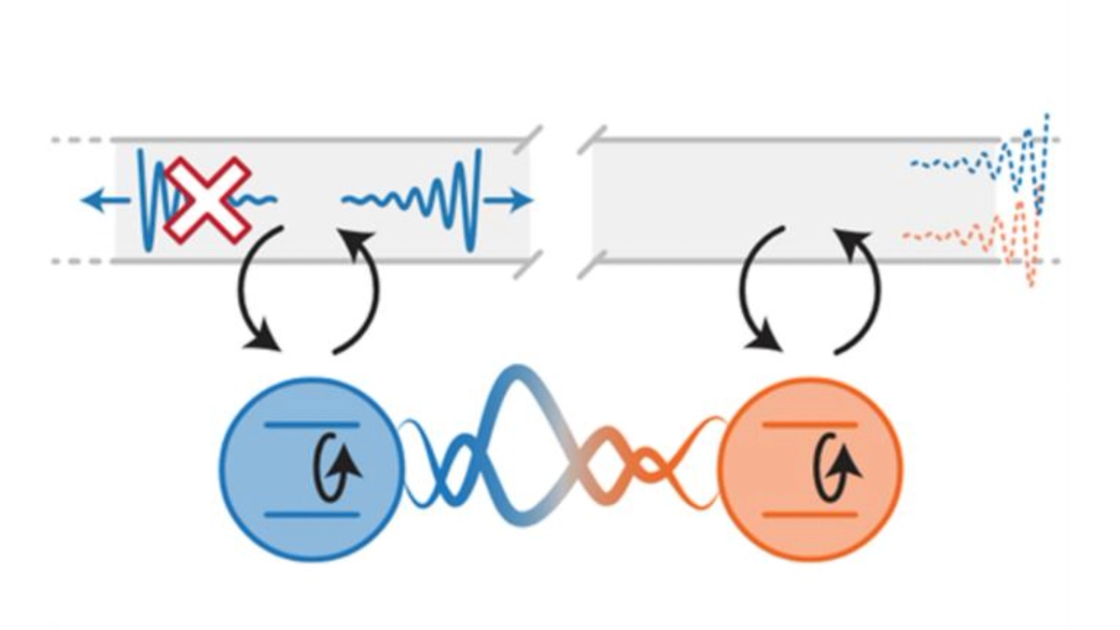
Physicists from the University of Illinois Urbana-Champaign and the University of Chicago have demonstrated a method in which carefully engineered dissipation can be used to generate and maintain quantum entanglement between superconducting qubits. The work builds on a theoretical prediction and introduces a technique called synthetic squeezing to make the approach more practical under real-world experimental conditions.
Why Quantum Entanglement Matters
Quantum entanglement is one of the most important resources in quantum information science. When two quantum systems become entangled, their properties can exhibit correlations that cannot be explained using classical physics. Entanglement plays an important role in quantum computing, quantum communication, quantum sensing and future quantum networks.
However, creating entanglement between physically separated quantum systems is difficult. Traditional approaches often involve preparing quantum states and then transporting them between different locations. During this process, interactions with the surrounding environment can introduce noise and weaken the entanglement.
This vulnerability to decoherence is one of the major challenges facing scalable quantum technologies.
Turning Dissipation Into an Advantage
The new approach takes a very different perspective. Instead of trying to completely eliminate the environment, researchers engineer the interaction between the quantum system and its environment so that dissipation helps drive the system toward an entangled state.
The researchers used a configuration involving superconducting qubits connected through a unidirectional waveguide. The quantum systems continuously interact with light, while some of that energy is allowed to dissipate into the environment.
By introducing external light in a carefully controlled manner, the system can reach a stable state in which the qubits become entangled.
From Temporary Entanglement to a Steady State
Another particularly interesting aspect of the research is the nature of the resulting entanglement. Conventional quantum operations often create an entangled state and then require that state to be preserved against environmental noise.
In the new approach, entanglement emerges as part of the system’s steady-state behavior. Rather than preparing entanglement once and watching it gradually disappear, the system is continuously driven toward an entangled state. This could potentially provide a more robust mechanism for maintaining entanglement in future quantum systems.
The Role of Entanglement Distillation
One particularly promising direction is entanglement distillation. In practical quantum systems, it is difficult to generate perfectly entangled states. Instead, researchers may obtain multiple states with imperfect or relatively low levels of entanglement.
Entanglement distillation aims to combine these resources so that a smaller number of quantum states with significantly higher entanglement can be produced. The research team has identified this as a potential next step for their dissipative entanglement approach. If successful, such techniques could help transform the generated entanglement into a resource suitable for actual quantum computing operations.
Source
This article is based on recent research reported by The Quantum Insider and the underlying research published in Physical Review X.