Quantum computing discussions often focus on scaling monolithic processors: packing more qubits onto a single silicon chip or into a solitary dilution refrigerator. Yet throughout computing history, standalone computing machines only unlocked their transformative value once they could reliably exchange information across networks.
A parallel architecture is now emerging in physics and hardware engineering: the quantum internet.
A quantum network is not intended to be a faster replacement for standard optical fiber broadband. The classical internet transmits discrete information packets encoded in intense light pulses, electrical signals, or radio frequencies, which can be duplicated, amplified, routed, and measured at any point along the network path.
In contrast, a quantum network distributes delicate quantum states, phase relationships, and non-classical correlations known as entanglement across physical distances. Building this capability requires fundamentally rethinking communication hardware, optical transmission, and networking protocols.
Why Classical Networking Rules Do Not Apply
In standard telecommunications, signals traveling through optical fiber attenuate exponentially, losing roughly half their optical power every 15 kilometers (averaging 0.2 dB/km in standard telecom silica fiber). Classical networks overcome this by placing optical amplifiers, such as Erbium-Doped Fiber Amplifiers (EDFAs), at regular intervals. These amplifiers detect incoming weak optical pulses and re-emit amplified copies to keep the signal moving across continents.
In a quantum network, this approach fails because of a foundational law of physics: the No-Cloning Theorem, proven by William Wootters and Wojciech Zurek in 1982. The theorem establishes that an unknown, arbitrary quantum state cannot be replicated perfectly.
Any attempt to intercept and amplify a quantum signal introduces measurement backaction, collapsing superpositions and destroying non-classical phase relationships. Conventional repeaters and amplifiers simply cannot be placed into a quantum link.
Instead, a quantum network must transmit individual quantum states or distribute entangled photon pairs directly to destination nodes, requiring near-zero loss components and specialized quantum protocols.
Entanglement as a Network Currency
At the heart of quantum networking lies quantum entanglement. When two or more particles become entangled, their quantum states are fundamentally linked. A measurement performed on one particle correlates instantaneously with the outcome of a measurement on the other, regardless of the physical distance separating them.
Entanglement does not transmit classical data faster than light, which is strictly prevented by the No-Communication Theorem. Instead, distributed entanglement acts as a physical resource. When paired with a conventional classical communication channel, shared entanglement enables protocols that are physically impossible in classical systems:
- Quantum State Teleportation: Reconstructing an exact, unknown quantum state from a source node to a target node without physically transporting the particle itself.
- Distributed Quantum Computing: Allowing separate quantum processing units to execute coordinated quantum algorithms as a single, coherent cluster.
- Quantum Key Distribution (QKD): Establishing cryptographic keys with information-theoretic security guaranteed by the laws of quantum mechanics rather than mathematical computational assumptions.
Why Photons Are the Natural Carriers of Quantum States
For quantum information to travel, it requires a “flying qubit” capable of moving rapidly with minimal environmental disturbance. Photons are the ideal candidate for several reasons:
- Velocity and Coherence: Photons travel at the speed of light and interact very weakly with ambient thermal environments at room temperature, allowing them to preserve phase coherence far better than electrons or trapped ions.
- Existing Fiber Compatibility: Photons can propagate through existing telecommunication optical fibers when generated at standard low-loss wavelengths, specifically the telecom C-band (around 1550 nm) and O-band (around 1310 nm).
- Versatile Encoding Degrees of Freedom: Quantum information can be encoded into photons in diverse ways: discrete variables such as polarization, time-bin, and path modes, or continuous variables such as the field quadratures of squeezed optical states.
However, moving quantum light through standard optical fiber is not without obstacles. Fiber birefringence causes polarization drift, chromatic dispersion broadens wave packets over distance, and thermal fluctuations or mechanical vibrations constantly perturb optical phase.
Real-World Progress: The 62-Kilometre NIST Field Trial
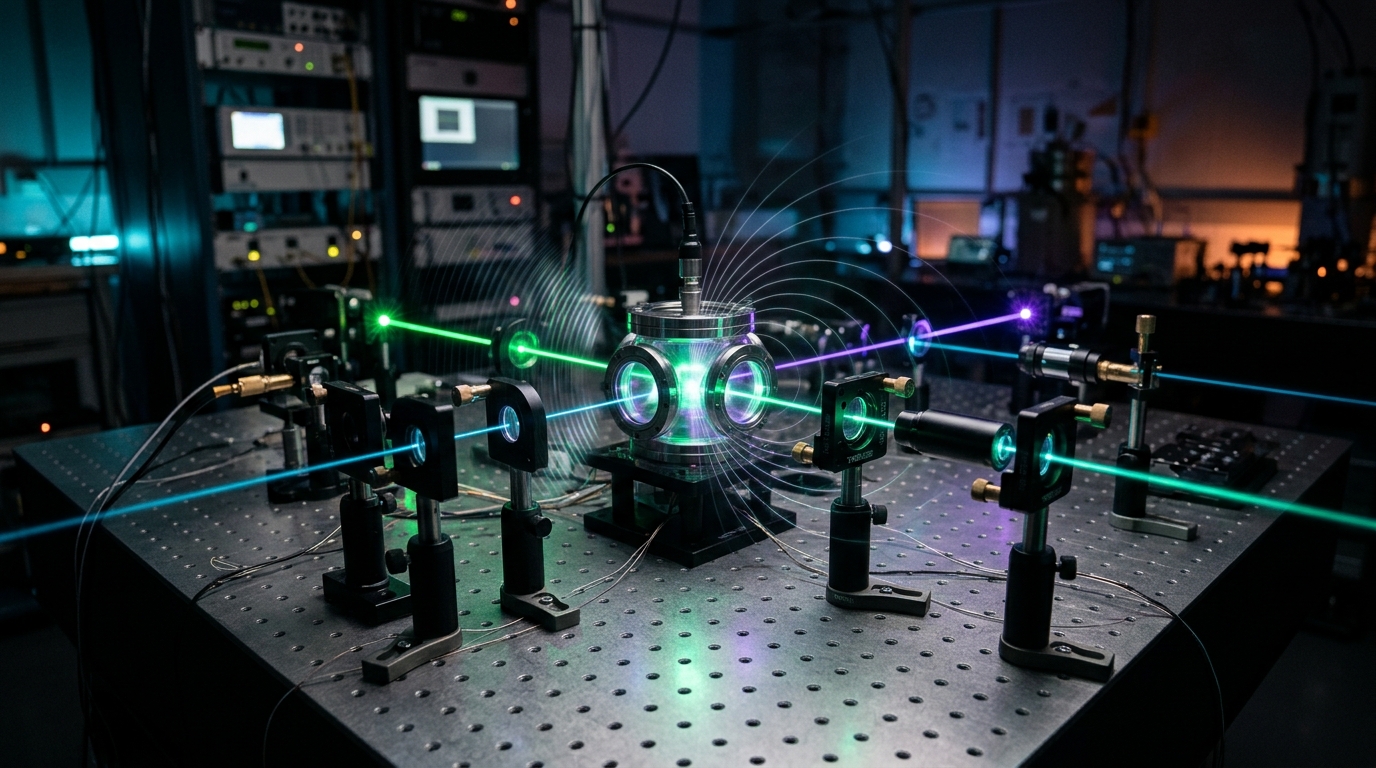
Moving quantum networks from isolated optical benches to operational fiber infrastructure is one of the most significant engineering transitions underway.
In a notable demonstration conducted by researchers from the US National Institute of Standards and Technology (NIST) and collaborating institutions, entangled photon pairs were successfully distributed across a 62-kilometer loop of commercial fiber between facilities in Maryland.
What made this milestone significant was the operating environment. The link was not a pristine laboratory testbed. It included substantial segments of aerial optical fiber suspended on utility poles, directly exposed to ambient temperature swings, wind buffeting, and highway vibration.
To prevent these external disturbances from destroying the fragile shared quantum state, the team engineered real-time automated stabilization systems that continuously measured and compensated for polarization rotations and phase drift. The experiment demonstrated that high-fidelity entanglement distribution can survive in deployed commercial telecom infrastructure under realistic environmental conditions.
Details on the experimental setup can be found in the NIST research announcement.
Core Capabilities Enabled by Quantum Networks
A mature quantum internet will not serve routine web browsing or video streaming. Instead, it creates capabilities specific to quantum technologies:
Modular Scaling and Distributed Quantum Computing
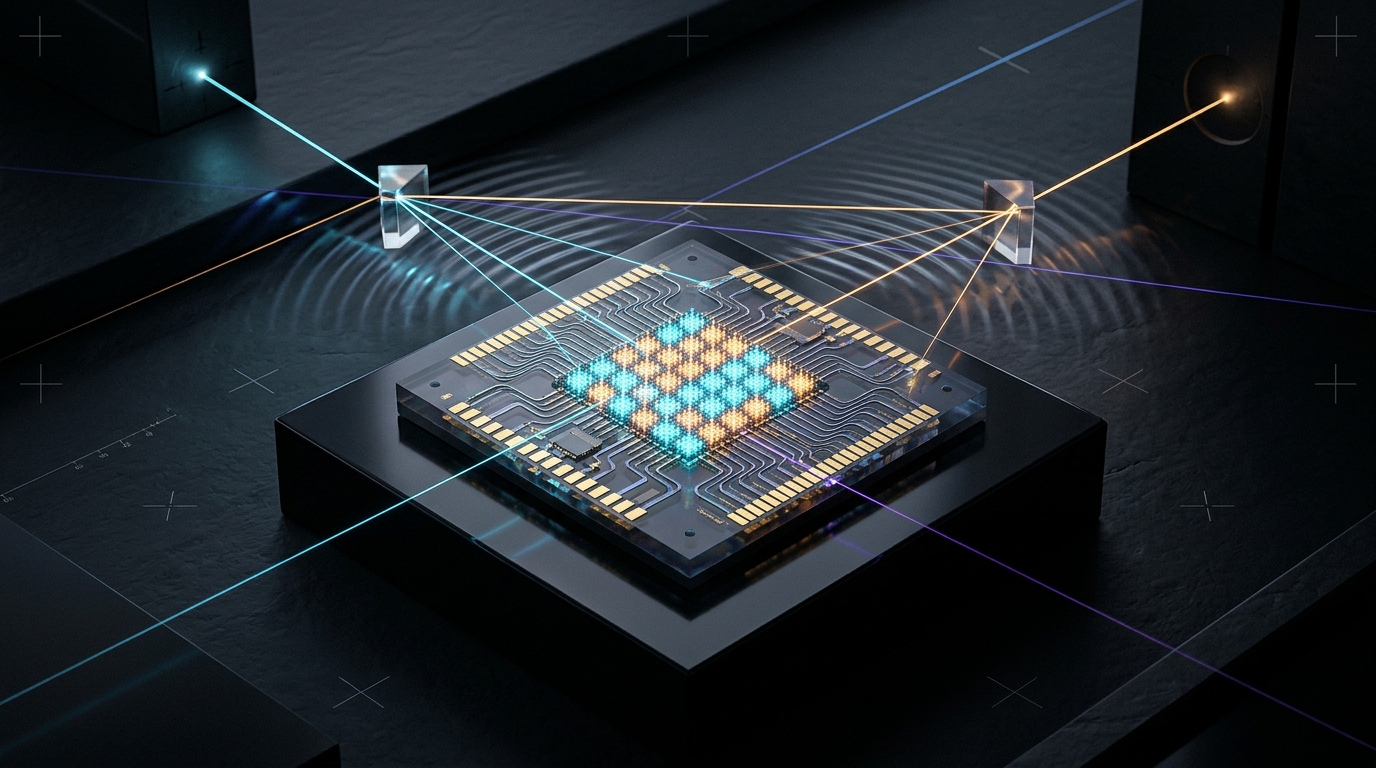
Single quantum processors face physical limitations in scaling qubit counts, whether constrained by dilution refrigerator volume, optical cross-talk, or chip packaging complexity. Connecting multiple smaller quantum processing units through low-loss optical links allows modular quantum architectures to scale horizontally into distributed quantum supercomputers.
Quantum Key Distribution and Cryptographic Verification
Quantum key distribution enables two parties to produce a shared random secret key. Because any eavesdropper attempting to intercept or copy the flying photons alters their quantum state, the communicating parties can detect eavesdropping attempts immediately. QKD provides hardware-level physical security that complements software-level post-quantum cryptography (PQC) algorithms.
Distributed Quantum Sensing and Metrology
Networks of quantum sensors can harness entanglement across geographic baselines to dramatically improve measurement precision, operating beyond the standard quantum limit. This offers major advancements for long-baseline optical interferometry in astronomy, atomic clock synchronization, gravimetry, and geophysics.
The Repeater Bottleneck: Bridging Continental Distances
Because optical fiber attenuation cannot be counteracted with traditional amplifiers, direct transmission of single photons over standard fiber drops below practical rates beyond roughly 100 to 150 kilometers.
To connect nodes over regional and intercontinental distances, researchers are developing quantum repeaters. Rather than amplifying signals, a quantum repeater segments a long distance into shorter spans:
- Neighboring nodes generate and distribute entangled photon pairs across short, low-loss spans.
- Quantum memories at intermediate nodes store the quantum states temporarily.
- Once adjacent links are confirmed, intermediate nodes execute an operation called entanglement swapping (a Bell-state measurement), stitching the short entangled segments into an end-to-end entangled link between distant endpoints.
Building reliable quantum repeaters remains a defining hardware challenge. It demands quantum memories with millisecond-to-second coherence times, low-noise optical interfaces, and high-efficiency single-photon detectors.
Where Photonic and Continuous-Variable Systems Fit In
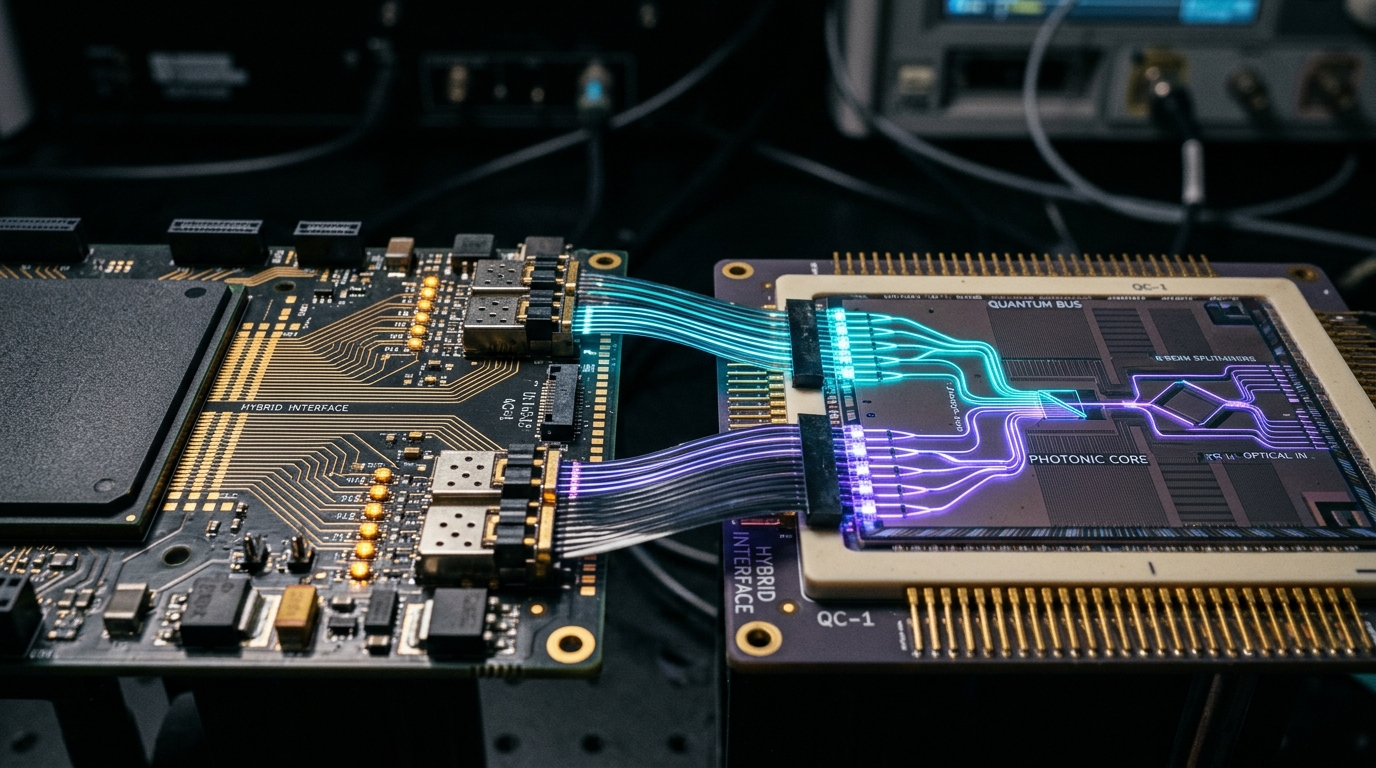
Many contemporary quantum computing platforms, such as superconducting transmons and trapped ions, operate using microwave frequencies or localized electronic states. Connecting these processors to an optical quantum network requires converting microwave photons into optical photons through electro-optomechanical or magneto-optic transducers. These conversion steps introduce insertion losses and thermal noise that severely degrade the quantum state.
This is where photonic quantum computing platforms offer a distinctive architectural advantage. In systems developed by OJANVU Quantum Labs and across the broader photonic research landscape, quantum information is already encoded in optical modes and photons.
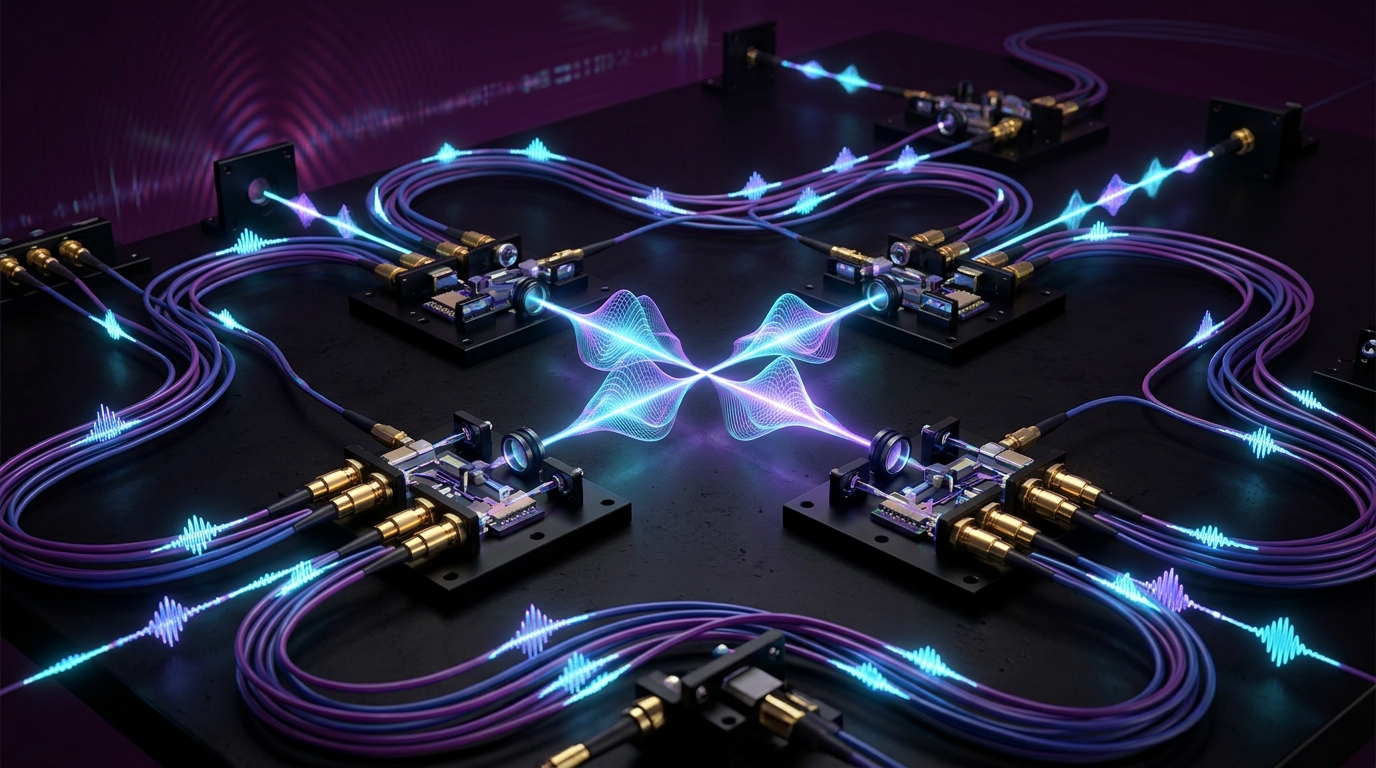
In continuous-variable (CV) quantum optics, information resides in the continuous quadratures of light fields. Squeezed light states and optical cluster states operate natively at optical frequencies and at room temperature. Because they share the same physical medium as telecommunication fiber networks, photonic quantum systems eliminate the need for complex microwave-to-optical transduction, simplifying direct node-to-node optical interconnection.
Key Hardware Priorities Ahead
Transitioning from localized laboratory demonstrations to robust, multi-node quantum networks requires solving specific hardware and engineering bottlenecks:
- High-Rate, Deterministic Optical Sources: Moving from probabilistic photon generation to deterministic, high-repetition-rate single-photon and squeezed-light sources.
- Low-Loss Optical Switching and Multiplexing: Developing fast, low-insertion-loss integrated optical switches to route quantum states dynamically without degrading fidelity.
- Integrated Quantum Memories: Realizing solid-state, atomic, or optical-cavity quantum memories with long storage times and high read-out efficiencies.
- Autonomous Stabilization Systems: Expanding automated phase and polarization tracking hardware that compensates for thermal and mechanical stress on field-deployed fibers.
- Standardized Control Protocols: Defining network-layer abstraction protocols that coordinate entanglement routing, purification, and verification across heterogeneous quantum hardware platforms.
The Path Forward: From Isolated Nodes to Coherent Networks
The development of quantum technology is entering an era where interconnectivity is just as vital as raw qubit counts. Monolithic quantum devices have proven what quantum mechanics makes possible in isolation; the next step is discovering how these systems can share quantum information coherently.
Photons remain the primary bridge across this frontier. Through resilient optical engineering, field-tested stabilization, and continuous-variable optics, the building blocks for an interconnected quantum future are steadily moving into place.